

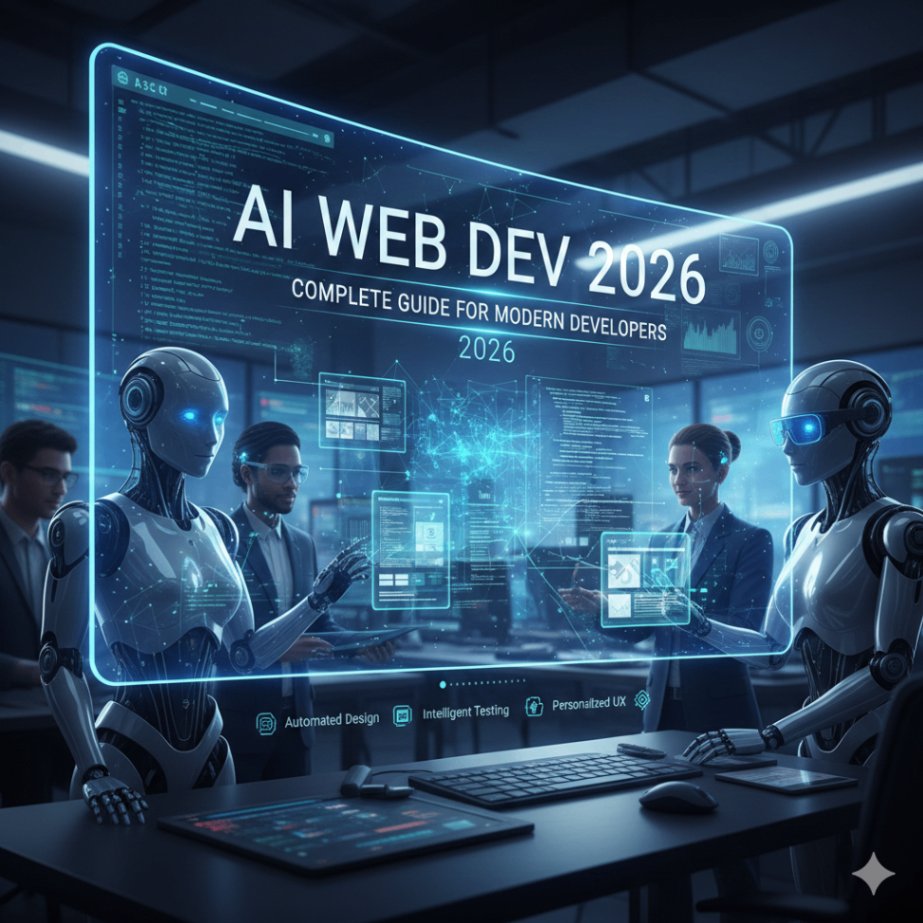
Artificial Intelligence has become the most powerful force reshaping how developers build, deploy, and maintain modern web applications. What started as an experimental feature in developer tools has now become an essential part of the web development workflow in 2026. Today, developers who understand how to leverage AI effectively are building products faster, with better quality, and with fewer resources than ever before.
The web development landscape in 2026 is fundamentally different from just two years ago. Cloud infrastructure matured, JavaScript frameworks stabilized, but the biggest shift came from AI integration. What was once considered futuristic is now mainstream. From code generation to automated testing, from security vulnerability detection to performance optimization, AI is involved at every layer of the development stack.
One of the most impactful changes is AI-assisted code writing. Tools powered by large language models can now understand the context of your project, suggest complete function implementations, refactor legacy code, and even help generate unit tests. A developer working with these tools can accomplish in hours what previously took days. This does not mean developers are less important. Rather, they focus on higher-level problems like architecture design, business logic, and user experience instead of writing repetitive boilerplate code.
For PHP developers specifically, this transformation opens new opportunities. PHP powers approximately 77 percent of all websites with a known server-side programming language. WordPress, which runs roughly 43 percent of all websites, is built on PHP. This massive installed base means there are countless legacy projects that need modernization. AI tools can help developers understand old codebases, identify technical debt, and systematically improve them. A developer can now analyze thousands of lines of code and receive intelligent suggestions for refactoring in minutes.
The testing landscape has transformed dramatically. Traditional unit testing was a tedious process that required developers to write test cases manually. AI-powered testing frameworks now generate comprehensive test suites automatically. These systems understand your code logic and create tests that cover edge cases humans might miss. The result is more robust applications with fewer bugs making it to production. This is particularly valuable for small teams where writing tests felt like a luxury they could not afford.
Security has become more intelligent too. Web applications today face countless attack vectors. AI systems trained on millions of vulnerabilities can now scan your code and instantly flag potential security issues before they become exploitable. They can suggest fixes with code examples. Developers no longer need to be security experts to write reasonably secure applications. The AI handles the heavy lifting while developers focus on implementing business features.
Database optimization is another area where AI has made tremendous impact. Query performance is critical for web application success. Modern AI tools can analyze your database patterns, identify slow queries, suggest index improvements, and even recommend schema changes. This was previously the domain of database specialists. Now, a full-stack developer with an AI assistant has capabilities that rival specialized DBAs.
The deployment and DevOps side has also been revolutionized. AI systems monitor production environments, detect anomalies, predict failures before they happen, and suggest preventive actions. They can analyze logs containing millions of entries and identify the root cause of issues in seconds. They recommend optimizations based on real usage patterns. This means smaller teams can now manage applications at scale that previously required dedicated operations teams.
Customer-facing features have become more intelligent as well. AI-powered recommendations, personalization engines, and chatbots are no longer premium features available only to large corporations. Modern PHP frameworks integrate easily with AI APIs that provide these capabilities. A solo developer can build a personalized web experience that adapts to each user’s behavior and preferences.
The economics of web development have shifted significantly. AI tools reduce the time and cost of building, maintaining, and improving applications. This democratizes web development. Someone with fundamental programming knowledge can now build sophisticated applications that would have required a team of specialists just a few years ago. This creates opportunities for entrepreneurs and small businesses to compete with larger players who previously had more resources.
However, this transformation also brings new challenges. Developers must learn how to work effectively with AI tools. Understanding their strengths and limitations is crucial. Not all AI-generated code is production-ready. Developers must still review, test, and validate everything. The tools are incredibly helpful, but they are not replacements for judgment and experience. A developer’s value increasingly comes from knowing which AI suggestions to accept, which to modify, and which to reject entirely.
Future-proofing a development career in 2026 requires embracing these tools while maintaining strong fundamental skills. Understanding computer science principles, architecture patterns, and system design is more important than ever. These foundations help you understand when and how to use AI tools effectively. A developer who combines deep technical knowledge with AI tool expertise has significant competitive advantage.
The path forward for web developers involves continuous learning and experimentation. Try different AI-powered tools and understand their capabilities. Integrate them into your workflow. Learn how to prompt them effectively. Understand their limitations. Use them to automate tedious tasks so you can focus on creative and strategic work. The developers thriving in 2026 are those who view AI as a force multiplier rather than a threat.
As we move deeper into 2026, the integration of AI into web development will only deepen. New tools will emerge. Existing tools will become more sophisticated. The developers who stay curious, experiment continuously, and adapt their workflows will find unlimited opportunities in this rapidly evolving field. The future of web development is not about choosing between AI and human expertise. It is about combining both to build better applications faster than ever imagined possible.